Why Self-Directed Dieting Keeps Failing You
If you’ve ever stared into a fridge full of ingredients and ordered takeout instead, you’ve collided with a cognitive wall that has nothing to do with laziness. Researchers call it decision fatigue—the progressive deterioration of your ability to make sound choices after making too many of them. Food is uniquely punishing: a Cornell study estimated that the average adult makes over 220 food-related decisions daily, from “Is this hunger or boredom?” to “How many grams of protein did I already eat today?” Each one quietly drains the same mental reservoir you need for work deadlines, parenting patience, and saying no to the office donuts.
Self-directed dieting demands that you become a part-time nutritionist, meal planner, and accountant—simultaneously and indefinitely—on top of your actual life. When that system collapses around week three, the cultural narrative whispers that you simply lacked discipline. But the structural reality is that consistent self-planning requires a level of cognitive bandwidth that a busy schedule actively destroys. Your prefrontal cortex, the brain region responsible for restraint and planning, is the same one getting hammered by every other demand in your day. Expecting it to flawlessly manage calorie math after a 10-hour shift is like expecting a phone at 3% battery to run a software update.
This is where the core trade-off becomes useful rather than shame-inducing. Self-directed eating saves money but demands constant cognitive bandwidth. Structured programs cost money but remove that mental load. Neither path is morally superior—they’re simply different resource allocations. The question isn’t “Why can’t I stick to a diet?” but rather “At what point in my day does my system actually break down, and what type of structure would intercept that failure?”
The Three Types of Meal Plan Weight Loss Programs
Most structured weight loss programs fall into three distinct tiers. Picking the right one comes down to a brutally honest assessment of where your schedule actually breaks down.
1. Fully Pre-Made Meal Delivery
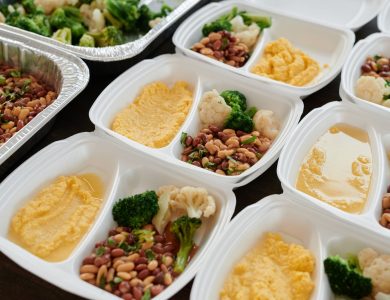
These arrive at your door cooked, portioned, and ready to heat in two minutes. Companies like Factor and Diet-to-Go operate in this space, with plans typically running $10–$15 per meal. The mental load is near zero—no chopping, no measuring, no thinking. The trade-off is cost, and a fridge full of identical containers. This tier serves the person who will genuinely not cook, period, and who’s willing to pay a premium to remove every possible point of friction between them and a calorie-controlled plate.
2. Hybrid Meal Kits with Calorie-Controlled Recipes
Services like Blue Apron’s Wellness plan or Home Chef’s Calorie-Conscious option ship pre-portioned ingredients with recipe cards that keep you within a specific calorie range, often $8–$12 per serving. You’re still cooking, but the planning and sourcing are handled. According to the Cleveland Clinic, the simple act of cooking at home is associated with higher diet quality—but that only matters if the ingredients are already in your kitchen. This tier fits the person who doesn’t mind 20–30 minutes at the stove but will abandon healthy eating the moment it requires a grocery list.
3. Digital-Only Structured Plans
These are app-based or PDF guides—think Noom’s structured curriculum or a registered dietitian-designed meal plan with weekly shopping lists—costing $15–$50 monthly. You handle all procurement and preparation yourself, but the architecture of what to eat and when is built for you. The mental load is highest here, but it’s directed: you’re executing a plan, not inventing one. This serves the person who can shop and cook consistently but has burned out trying to be their own nutrition researcher.
When Your Schedule Kills Consistency: Why Delivery-Only Programs Win
If your week runs on a schedule where “free time” is a theoretical concept, the first thing to collapse isn’t your motivation—it’s your refrigerator. You might genuinely intend to cook, but when 7:30 p.m. hits and you’ve just walked in the door, the mental energy required to wash a pan, let alone parse a recipe, evaporates. This is where fully pre-made, delivery-only meal plan weight loss programs stop being a luxury and start functioning as the structural fix your calendar demands.
Services like Factor, Diet-to-Go, and Nutrisystem Complete eliminate every friction point between you and a calorie-controlled plate. There is no grocery list, no chopping, and no calculating. You heat the meal for two minutes, eat it, and move on. The psychological win isn’t the convenience; it’s the death of the 5 p.m. panic. When the decision is already made and sitting in your fridge, the drive-thru loses its gravitational pull. By removing the daily negotiation with yourself, these programs protect your limited executive function for the rest of your life.
The trade-off is transparent: you’re swapping money for reclaimed time and cognitive bandwidth. Weekly costs for fully prepared meal plans typically run between $100 and $160, which can initially feel steep. But run the honest math against what you’re currently spending. A single daily takeout dinner plus a wasted bag of spinach you optimistically bought on Sunday often exceeds that figure. If your current reality involves late-night delivery app orders or protein bars masquerading as dinner, the premium you pay for a delivery-only program is often a wash—or even a net savings—before you factor in the value of consistency.
When You Want to Cook But Can’t Handle the Planning: Hybrid Kits
You know the ritual: you open a recipe app with genuine motivation, then spend 45 minutes bouncing between tabs—one for a low-carb stir-fry, another for a Mediterranean bowl, a third trying to calculate whether the portions fit your calorie target. By the time you’ve built a grocery list, your brain is fried and the pizza delivery app is already open. The cooking isn’t the problem. The planning is what breaks you every single time.
Hybrid meal kit programs solve this by collapsing the entire decision chain into a single choice: which box arrives at your door. Services like HelloFresh Calorie Smart, Blue Apron Wellness, and Home Chef Fresh Start pre-select recipes that hit specific calorie and macro ranges—typically 500–650 calories per serving with balanced protein, carbs, and fat. You skip the research phase, the portion-guessing, and the “did I buy enough cilantro for three different meals” spreadsheet. The ingredients show up pre-portioned, and you spend 30–40 minutes cooking, which scratches the itch for a home-cooked meal without the mental marathon that precedes it.
There’s a hidden long-term benefit here that pure convenience plays don’t offer: repetition teaches you what a properly sized plate looks like. After a few months of assembling meals where the chicken breast is always 5–6 ounces and the olive oil comes in a measured packet, your eye calibrates. You start internalizing the ratios without counting grams. One of the most effective predictors of weight maintenance is the ability to estimate portions accurately without tools—a skill these programs build passively.
Cost lands in the $9–$13 per serving range, which is more than scratch cooking but meaningfully less than fully prepared meal delivery. If your failure point is the hour you lose in the recipe rabbit hole rather than the act of standing at a stove, this category is designed to intercept you at exactly that moment.
When Your Budget Is Tight But You Need External Guardrails: Digital Plans
If your brain short-circuits the moment you stand in front of an open fridge without a plan, but your wallet can’t stomach a weekly meal-delivery subscription, you’re the exact person digital meal plan weight loss programs were built for. These aren’t vague “eat more vegetables” pep talks. They’re pre-designed, day-by-day blueprints—complete with grocery lists, exact portion sizes, and scheduled meals—that you execute yourself. You trade the cost of convenience for the labor of following orders, and for the right person, that’s a bargain.
Programs like eMeals or Skinnytaste’s weekly meal plans hand you a structured eating schedule tied directly to a downloadable shopping list. You’ll know precisely how many ounces of chicken to buy and which dinner lands on Thursday. WeightWatchers now integrates recipes and barcode scanning into its app so the points math happens automatically, while Noom’s meal guidance layers calorie-density education on top of a flexible framework. The common thread: someone else did the nutritional architecture. You’re responsible for the construction.
The financial math is compelling. Digital meal plans typically run $5–$30 monthly, compared to the $100–$200 weekly per-person cost of fully prepared meal delivery. But the price gap exists for a reason. You still need to grocery shop, cook, portion out containers, and—crucially—resist the urge to swap Tuesday’s salmon bowl for leftover pizza because “it’s been a long day.” If your failure point is purely decision paralysis during the design phase, a digital plan solves that for pocket change. If your failure point is exhaustion at 6 p.m. when it’s time to cook, no PDF will save you—and you’d be better off honestly assessing whether a hybrid meal-delivery model fits your reality instead.
How to Diagnose Your Real Failure Point Before You Spend a Dollar
Before you swipe your credit card, do a brutally honest autopsy on your last month of attempted healthy eating. Don’t generalize. Log every single time you veered off course—not with shame, but with the clinical detachment of someone troubleshooting a system. What actually happened in the moment you ordered the pizza or hit the drive-thru?
Now, sort each slip into one of four categories. Time failures mean you had no window to shop, chop, or cook—you walked in the door at 8 p.m. and there was nothing edible in the fridge. Planning failures mean you had time and a stocked kitchen, but no idea what to make, so you defaulted to whatever was easiest. Energy failures mean the ingredients were there and you knew the recipe, but you were so drained that standing at a cutting board felt impossible. Portion failures mean you cooked a healthy meal but ate twice what your body needed because nothing external signaled when to stop.
Each failure pattern points to a completely different solution—and buying the wrong one guarantees another abandoned attempt. If time is your bottleneck, you need fully prepared meal delivery, not a kit that requires 40 minutes of cooking. If planning is where you collapse, pre-designed meal kits with exact ingredients solve that specific step. If energy is the issue, look for ready-to-eat options that only need a microwave. If portions are your blind spot, pre-portioned anything—frozen meals, calorie-controlled containers, or macro-counted subscriptions—provides the guardrails you lack.
This is what it means to buy back your bottleneck. You’re not paying for a program’s brand or its Instagram aesthetic. You’re spending money on the one step in the chain where you consistently break down, and nothing else. Be ruthless in your self-assessment: if you genuinely don’t have 30 minutes to cook on weeknights, a meal kit with gorgeous recipe cards is expensive guilt sitting in your refrigerator. The most effective weight loss approach is the one you can adhere to consistently—not the one that looks optimal on paper. Match the program to your actual failure point, not the version of yourself you wish showed up at 6 p.m. on a Tuesday.
What Experts Recommend: Look for These Structural Features, Not Just Calories
If you’ve been burned by a program that worked until it didn’t, the problem probably wasn’t your willpower—it was the architecture of the plan itself. Most marketing shows you the six-week transformation. What you need to evaluate is what happens in week seven, and whether the nutritional scaffolding can hold up a human life.
Adequate protein and fiber are non-negotiable
The broad nutritional consensus—echoed by the Mayo Clinic and the Academy of Nutrition and Dietetics—is that any calorie-restricted plan must prioritize two things to be sustainable: enough protein to preserve lean muscle mass during loss, and enough fiber to generate satiety without inflating calories. If a program’s daily menu routinely falls below 0.6–0.8 grams of protein per pound of body weight, or offers so little fiber that you’re hungry an hour after eating, the calorie math might look good on paper but your biology will eventually override it. You’ll binge, blame yourself, and the cycle repeats.
A maintenance phase signals long-term thinking
Programs that keep you on an aggressive deficit indefinitely are structurally designed for regain. A defined transition or maintenance phase—where calories gradually increase back toward your total daily energy expenditure—is the single strongest signal that a program understands weight loss as a metabolic process, not a sprint. If the plan has no explicit off-ramp from severe restriction, you’re looking at a business model that depends on you failing and re-enrolling, not a health intervention.
Flexibility is a feature, not a concession
Life is unpredictable. A rigid system that penalizes you for swapping a meal, pausing a week, or eating something off-plan treats normal human variability as a compliance failure. The strongest programs allow you to navigate those moments without financial punishment or guilt-driven messaging. Ask directly: can you skip a delivery week without losing your credit? Can you swap a meal you hate? If the answer is no, the system breaks the moment your schedule does.
Credentials over celebrity
Before-and-after photos are marketing assets, not evidence. A far more reliable quality signal is whether a registered dietitian (RD) was involved in menu design. RDs are bound by clinical training and professional ethics to build nutritionally complete plans—not photogenic ones. If the program’s website mentions celebrity endorsements more prominently than the credentials of the person who built the meals, treat that as a red flag.
Red Flags That a Meal Plan Weight Loss Program Will Waste Your Money
Spotting a bad program before you hand over your credit card isn’t about cynicism—it’s about recognizing the business models that profit from your desperation rather than your success. Here are four non-negotiables to screen for immediately.
The “proprietary fuel” trap. If the core of the plan requires you to buy the company’s own shakes, bars, or powdered supplements, you’re not paying for nutrition science—you’re paying for high-margin retail products dressed up as clinical tools. These items carry markups of 300–500% over manufacturing cost and exist to build recurring revenue for the company, not to teach you how to eat real food. A legitimate program may recommend a protein powder for convenience, but it won’t make branded consumables the engine of your deficit.
Promises of losing more than 2 pounds per week without medical supervision. Consistent rapid loss above that threshold almost always signals a crash diet that will trigger metabolic adaptation—your body downshifting calorie burn to match the starvation signal it’s receiving. The Mayo Clinic classifies safe, sustainable loss as 1–2 pounds weekly, and anything faster without a physician monitoring your labs is a binge-relapse cycle waiting to happen.
No pricing visible without a sales call. If you can’t find clear dollar ranges on the website and the only next step is “book a consultation,” you’re walking into a high-pressure funnel designed to extract a commitment before you can comparison-shop. This structure almost always conceals auto-ship agreements, multi-month lock-ins, and cancellation policies buried in fine print. Transparency is a feature of confidence; opacity is a feature of extraction.
Demonizing entire food groups or claiming monopoly on truth. Any program that insists carbohydrates are poison, lectins are the root of all disease, or their method is the only path to a calorie deficit is selling ideology, not evidence. Sustainable weight loss has multiple valid architectures—Mediterranean, DASH, flexible macro tracking—and a trustworthy program acknowledges that fact rather than building a walled garden of fear around its particular rules.
How to Start Without Overcommitting: Test-Driving a Program the Right Way
Most failed attempts aren’t failures of willpower — they’re failures of fit. The smartest way to avoid another expensive, discouraging cycle is to treat your first week as a low-stakes experiment, not a transformation launch.
Start with the shortest commitment the program offers. That might be a one-week meal bundle, a discounted introductory box (typically $40–$80 off the standard rate), or a monthly digital subscription with a clear, no-penalty cancellation policy. If the only option is a multi-month upfront payment, treat that as a red flag — reputable programs confident in their retention don’t need to trap you.
Run the program during a normal week. Not the week you’re unusually motivated after New Year’s, and not the week your in-laws are visiting. You need a realistic read on how the structure holds up against your actual schedule, not an idealized version of it. If the plan requires 20 minutes of morning prep and your real mornings are already chaos, you’ll feel that friction immediately — and that’s valuable data.
Track two things: weight, yes, but also what researchers call adherence ease. Ask yourself daily: did following the plan feel almost frictionless, or did I spend the day wrestling with hunger, complexity, or resentment? A Cleveland Clinic review of behavioral weight loss research emphasizes that early adherence, not early loss, is the stronger predictor of long-term success. If the scale drops three pounds but you were miserable every hour, the program won’t stick.
Set a decision deadline the day you start. When the trial ends, you’ll evaluate honestly: commit deeper or pivot to a different category. The goal isn’t to force a fit. It’s to gather enough evidence to make the next move without self-blame — because the program that works is the one that works with your life, not against it.
What Happens After the Program Ends: Building a Bridge, Not a Cliff
Here’s the fear that lives in the back of your mind whenever you consider paying for a meal plan: What happens when I stop? You’ve likely lost weight before, felt that rush of success, and then watched the scale creep back up the moment you returned to “real life.” That fear isn’t irrational—a 2020 meta-analysis in The BMJ found that most diets lead to weight loss at the 6-month mark followed by near-complete regain by 12 months. The question isn’t whether a program can make you lose weight; it’s whether it can teach you to keep it off.
The best programs treat themselves as training wheels, not a permanent crutch. During the active phase, they should be quietly transferring skills you’ll eventually execute independently: what a reasonable portion of salmon looks like, how to build a breakfast that holds you until lunch, which convenience-store snacks won’t sabotage your progress. If a program only works when you’re fully inside it, it hasn’t worked at all.
A sustainable exit looks like a staircase, not a trapdoor. Start by reducing delivered or pre-made meals gradually—move from 7 per week to 5, cooking 2 yourself using the program’s recipes and portion guidelines. A few weeks later, shift to 3 and 4. This lets you build grocery-shopping and meal-prep muscles while the safety net is still underneath you. Each successful home-cooked meal chips away at the belief that you can’t do this on your own.
Critically, maintenance may still involve some paid structure. A digital tracking app at $10–$20 per month, or a seasonal meal-plan subscription at $5–$15 monthly, costs far less than a full program—and it’s not failure. It’s a maintenance budget. The goal isn’t to need zero support; it’s to graduate from expensive, high-touch intervention to inexpensive, low-touch scaffolding that keeps you steady without consuming your mental bandwidth.